Side Dish
Individual Yorkshire Puddings
Original name: Yorkshire Pudding (Individual)
About this dish
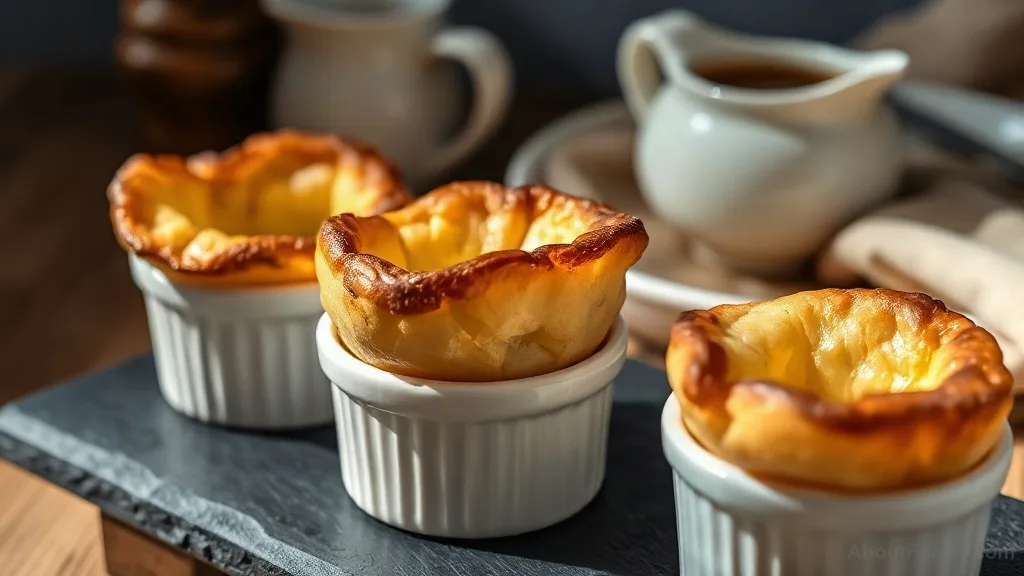
A proper Yorkshire pudding is not a dense, doughy muffin but a crisp, hollow vessel that shatters at the touch of a knife. This individual version is baked in a deep muffin tin so every one gets its own bronzed crown and tender, custardy base.
The secret is simple: get the fat smoking hot, pour in cold batter, and do not open the oven door until they have risen proudly. Legend has it that the name comes from the Yorkshire tradition of serving these puddings as a first course with gravy to take the edge off the appetite before the expensive meat arrived.
Today they are the essential companion to a Sunday roast, but individual puds are equally good with a spoonful of onion gravy, a dab of horseradish, or even a drizzle of golden syrup for a sweet finish.
Ingredients
UK and US measurements are both included for every recipe.
Plain flour
grain140 g
Imperial measurement: 1 cup + 1 tbsp
Fine sea salt
seasoning1/2 tsp
Large eggs
protein3
Whole milk
dairy240 ml
Imperial measurement: 1 cup
Cold water
liquid60 ml
Imperial measurement: 1/4 cup
Beef dripping or vegetable oil
fat4 tbsp
Method
Make the batter
5 minutesSift the flour and salt into a large mixing bowl. Make a well in the centre. Crack in the eggs and add half the milk. Whisk gently from the centre, drawing in the flour, until you have a smooth, thick paste. Gradually whisk in the remaining milk and the cold water until the batter is completely lump-free and has the consistency of single cream.
Rest the batter
30 minutes to 2 hoursCover the bowl with a plate or cling film and leave the batter to rest at room temperature for at least 30 minutes, or up to 2 hours in the fridge. This rest lets the flour hydrate fully and the starch grains relax, which gives a lighter, crisper rise.
Preheat the oven and the tin
10–15 minutesWhile the batter rests, preheat the oven to 220°C (200°C fan) / 425°F / Gas Mark 7. Place a 12-hole deep muffin tin on a baking tray and add 1 teaspoon of beef dripping or oil to each hole. Put the tin on the top shelf of the oven for 10–15 minutes, until the fat is shimmering and almost smoking. Do not skip this step: the fat must be properly hot, or the puddings will not rise.
Pour the batter into the hot fat
2 minutesWorking quickly and carefully, remove the hot tin from the oven. Give the batter a final whisk, then pour it into a jug. Fill each hole about two-thirds full. The batter should sizzle and bubble around the edges as it hits the fat. Close the oven door immediately.
Bake until risen and golden
20–25 minutesBake for 20–25 minutes, without opening the oven door, until the puddings are well risen, deeply golden, and crisp on the outside. If they look pale after 20 minutes, bake for a further 5 minutes. Resist the urge to peek, as a draught of cold air can cause them to collapse.
Serve immediately
2 minutesRemove the tin from the oven and, using a small palette knife or fork, lift the puddings onto a warm plate or into a napkin-lined basket. Serve straight away, while they are still crisp and hollow. They are best eaten within 10 minutes of coming out of the oven.
Equipment
- 12-hole deep muffin tin
- large mixing bowl
- balloon whisk
- measuring jug
- sieve
- baking tray
- palette knife or fork
Nutrition facts
Tips
- For the deepest rise, make the batter the day before and rest it in the fridge overnight, cold batter hitting hot fat creates the most dramatic puff.
- Use beef dripping or goose fat if you possibly can, as they give the most authentic flavour and crispness, but a neutral vegetable oil works perfectly well for a vegetarian version.
- Never open the oven door during the first 20 minutes of baking, as a sudden drop in temperature will make the puddings sink before they have set.
- If you are cooking a roast dinner, bake the puddings while the meat is resting, they need a hot oven and are best served straight away.
Serving suggestions
- Serve alongside a traditional Sunday roast of beef, lamb, or chicken, with plenty of onion gravy.
- Fill with a spoonful of leftover roast meat and gravy for a simple, comforting supper.
- For a sweet twist, drizzle with golden syrup or treacle and serve with a scoop of vanilla ice cream.
- Offer with a dollop of horseradish cream or English mustard for a punchy contrast.
Rate this recipe
No ratings yet. Be the first to rate it.

Recipe by
Harriet Pembroke
Specialises in British cuisineHarriet makes scones with clotted cream and jam (cream first, then jam — she is a Cornish loyalist).
Describe yourself in three words: Proper, creamy, scone wars.